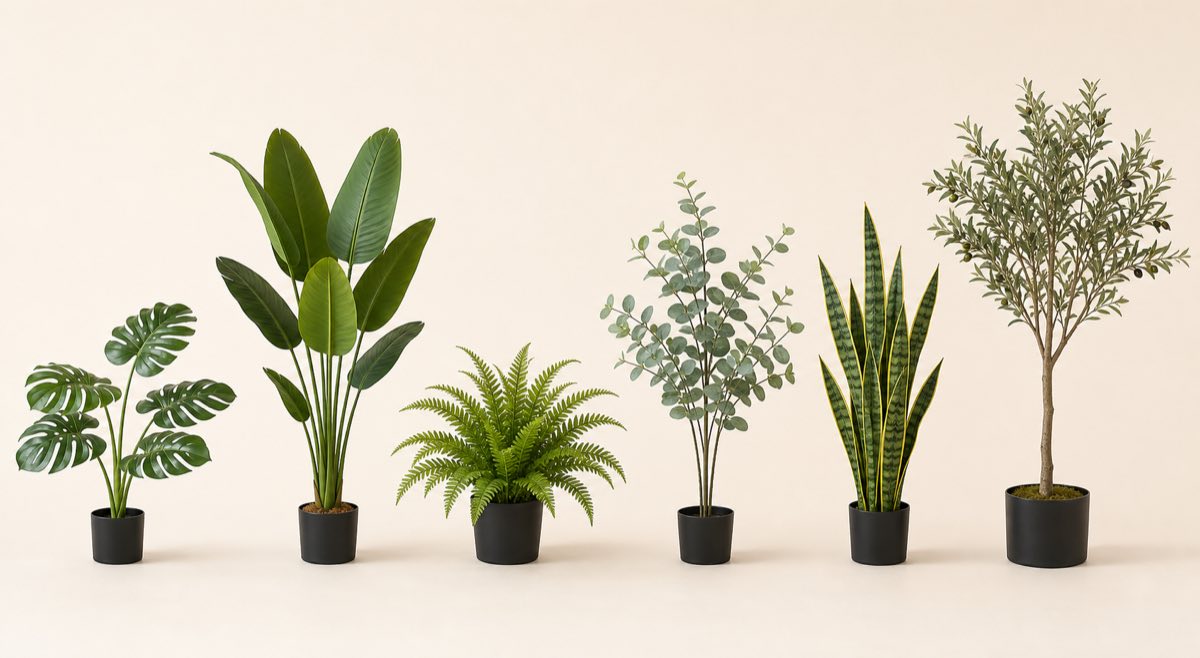
The cover illustrates a product family, not a fixed SKU assortment. Final products are confirmed by specification and sample.
The first artificial plant wholesale order should help a retailer learn what customers respond to without creating an unmanageable catalogue. Choosing dozens of similar styles may look comprehensive, but it can make sampling, stock identification and replenishment harder before demand is understood.
Start with product roles and store constraints. Then ask suppliers to quote a small, clearly specified assortment that can be reviewed and reordered consistently.
Give each product a role in the range
Separate the purposes your assortment needs to serve. A compact accent plant, a medium potted feature and a floor tree are not interchangeable simply because they share a leaf style.
Record the intended display area and likely customer use for each candidate. Some products may suit shelf displays; others may be selected for entrances or room corners. These are working assortment hypotheses, not proven customer preferences.
Avoid adding a new SKU unless you can explain what it contributes beyond an existing option: scale, silhouette, colour direction, planter treatment or a different use.
Compare size with the retail environment
Check shelf openings, display depth, aisle space and the height at which customers will see the foliage. Include storage and receiving areas, not only the selling floor.
VERDILORA's current medium potted directions include 60, 90 and 120 cm. The potted plant size guide can help structure this comparison. Treat those sizes as starting directions; approve the actual dimensions of the selected construction.
For every candidate, distinguish the assembled selling footprint from the packed footprint. A product that fits the display may still require more storage space or handling than anticipated.
Use a simple candidate matrix
A working sheet can contain:
- Product code and intended role.
- Overall height and maximum shaped width.
- Foliage and stem reference.
- Supplied pot and decorative-planter scope.
- Target initial quantity.
- Proposed units per carton and carton dimensions.
- Sample status and outstanding questions.
Use a separate row for each actual variant. Do not group different pot finishes or heights under one vague “assorted plants” description if receiving and inventory teams need to identify them individually.
Ask how minimum quantities apply
Minimum order quantity can apply to a construction, colour, size, packaging treatment or production route. A total order quantity does not automatically make every variant workable.
Ask the quotation to separate product-level requirements from the total order requirement. If mixed cartons are important, request confirmation of which combinations are possible and how they will be marked.
For a first order, identify which requirements are essential and which can wait. A new carton design or unusual planter colour may introduce a different approval route. Discuss the trade-off rather than assuming customization is included at any quantity.
Evaluate handling as well as appearance
Inspect a sample in conditions similar to the store: close viewing, overhead lighting and normal display access. Check how it looks immediately after unpacking, how much shaping it needs, and how easily staff can reproduce the approved presentation.
Keep the sample approval record with the product code. Include instructions, labels and packed presentation where these affect retail handling.
Think through the customer handoff too. Will customers collect an assembled plant, or take it home in a carton? If you sell online, request the proposed packaging information and review the intended delivery route. Do not assume ordinary export cartons have been verified for individual parcel shipping.
Compare cost on a consistent basis
Use the same specification, quantity and trade term when comparing quotations. Add known packing, freight and handling inputs separately. Duties, taxes and destination charges should be confirmed with the appropriate destination-side advisers rather than inferred from a product price.
Record preparation work such as assembly or reshaping as a planning consideration. A cheaper item may not be the better fit if the store cannot present it consistently. Conversely, do not pay for an appearance feature that customers will rarely see in the intended display.
Plan the reorder before expanding the range
Define which details should remain unchanged when replenishing: product code, dimensions, foliage colour direction, pot, labels and approved reference. Ask how changes will be disclosed and approved.
After launch, use actual sales, returns, customer questions and display feedback to decide which products deserve expansion. Keep the first order's assumptions separate from the evidence collected afterward.
Building your first assortment? Share a retail product brief with VERDILORA including your destination, display constraints, preferred product roles and initial quantity by candidate. Request options and packing details before committing to a wider SKU range.