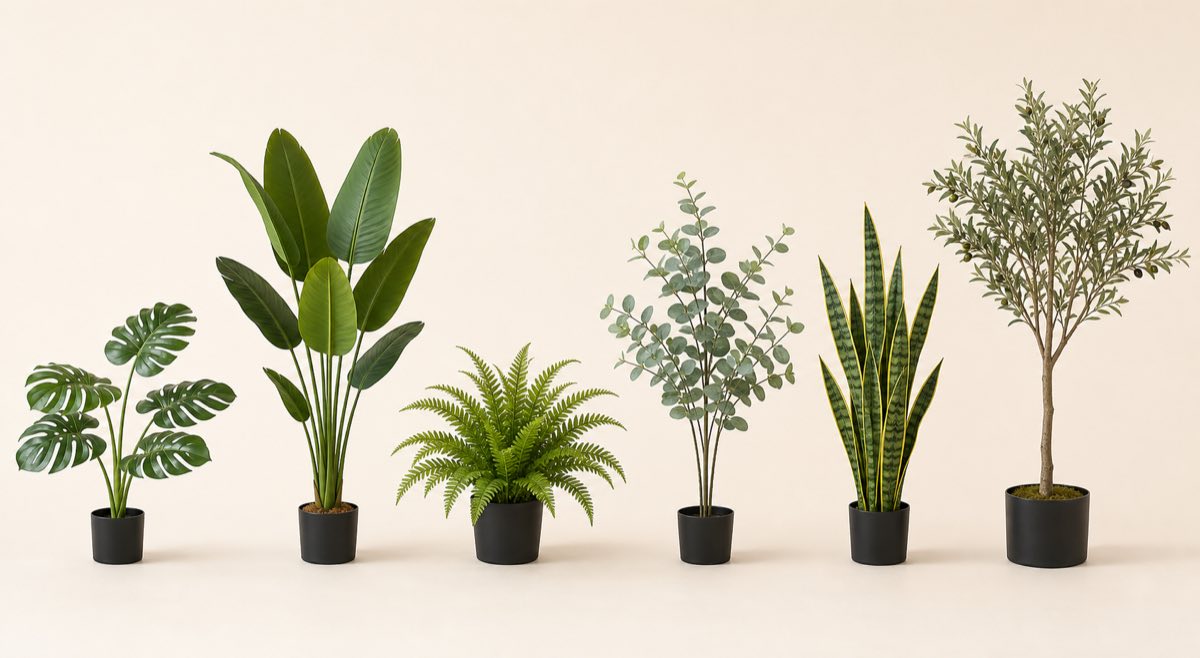
Commercial buyers comparing 60, 90 or 120 cm wholesale artificial potted plants need more than a style name and a front-view image. Offices, hotels, restaurants and retail spaces each create different sightlines, furniture relationships and access constraints. A useful brief connects the intended location with measurable product, planter, sample and packing requirements.
1. Start with the placement, then choose a height direction
VERDILORA’s current medium potted greenery family uses 60, 90 and 120 cm size directions. Treat them as starting points for discussion. Check the finished height against nearby furniture, signs, windows, circulation routes and the intended planter before selecting a direction.
- 60 cm direction: compare it where a lower greenery layer is needed and where furniture or display sightlines must remain open.
- 90 cm direction: review it for spaces needing a more visible mid-height silhouette without moving into floor-tree scale.
- 120 cm direction: consider it where the planting needs stronger vertical presence while remaining within the medium potted family.
These are selection directions, not universal placement rules. The approved specification should confirm the exact overall dimensions for the chosen product.
2. Define the dimensions buyers will actually see
Total height alone cannot describe how a potted plant fills a space. Put overall height, maximum foliage spread, exposed stem height and inner-pot dimensions on the same specification sheet. If the foliage can be shaped, note whether the recorded width represents the packed product, the opened sample or the approved finished silhouette.
Use front and side photographs with dimensions. This makes quotations easier to compare and gives sample approval a measurable reference.
3. Separate the inner pot from the decorative planter
The supplied inner pot and the decorative planter are not automatically the same item. Confirm what the quotation includes. When the decorative planter will be sourced locally, share its internal opening, internal depth and intended finished position so the plant and planter can be reviewed together.
Also check whether the decorative planter changes the visible height or creates a stability, fixing or filling requirement. The quotation should state which party supplies each component rather than leaving the planter assumption inside a reference image.
4. Match foliage shape to viewing distance and maintenance access
A plant viewed beside a reception desk needs different visual information from one seen across a hotel lobby or retail aisle. Review maximum spread, foliage density, leaf direction and the number of important viewing sides. Keep the intended cleaning and access route clear so the approved silhouette does not depend on placing foliage into walkways or working areas.
5. Add the application context to the product brief
For an office, identify whether the plant sits beside a desk, reception area, corridor or shared space. For hotels and restaurants, show the nearby seating, service routes and lighting. Hotel buyers can use the separate hotel artificial plant selection guide to build a zone schedule. For retail, include display heights, signage and customer circulation. The aim is not to claim that one size fits an entire sector; it is to give the supplier enough context to answer the right specification questions.
6. Approve the sample as a repeatable reference
Record the approved overall dimensions, foliage colour direction, density, stem appearance, inner pot, finished silhouette and packed presentation. Photograph the front, side, details and the product immediately after unpacking. If shaping is required, keep a short reference showing the approved result.
Use the full artificial plant sample approval checklist to align the written specification, photographs, labels and batch-check points.
7. Review packing and mixed-order identification
Confirm whether the approved construction is compressed or plug-in, how foliage and pots are protected, and what shaping or assembly information will accompany the product. When 60, 90 and 120 cm directions share an order, use clear product codes and carton marks so receiving teams can identify each size without opening every carton.
Quotation checklist for medium potted greenery
- Application and placement photographs, drawings or dimensions.
- Target quantity and preferred 60, 90 or 120 cm direction.
- Required total height, maximum spread and important viewing sides.
- Foliage and stem references, including acceptable visual variation to discuss.
- Inner-pot requirements and whether a decorative planter is included or sourced locally.
- Sample approval points and the required photo or specification record.
- Packing, product codes, carton marks and mixed-order identification.
- Destination and requested commercial timing for the supplier to confirm.
A concise brief helps commercial artificial potted plants move from a visual shortlist to a comparable quotation. It also exposes assumptions about size, planter, sample and packing before they become order differences.